






01
Intent Understanding
Read the underlying goal - not the surface request. CINTENT resolves ambiguous asks into precise, evaluated intents.
Traditional AI responds to instructions. CINTENT first understands the purpose behind them.
Cognivanta Labs develops CINTENT™, a governed cognitive intelligence platform that understands intent, interprets context, reasons across knowledge and constraints, makes accountable decisions and enables purposeful action.
Cognivanta Labs builds cognitive AI systems that understand intent, maintain context, evaluate constraints and produce governed, structured decisions ready for human approval or real-world execution.
CINTENT is not a chatbot and not RPA. It is the reasoning surface where enterprise constraints, human judgment, and structured decisions meet.
Read the underlying goal - not the surface request. CINTENT resolves ambiguous asks into precise, evaluated intents.
Reason across user, business, environmental and historical context before proposing a path forward.
Durable episodic + semantic memory keeps prior decisions, constraints and outcomes available across sessions.
Every candidate path is scored against policy, regulation, risk tolerance and operational constraints.
Human approvals, audit trails, and hard policy boundaries. Nothing acts without an explicit sign-off surface.
Structured decisions with confidence, risk, evaluated constraints and clear action steps - ready to execute.
Text, voice, documents, sensors, workflow events converge as intent signals.
Semantic parsing resolves objective, user, business and environmental context.
Candidate paths are generated across policy, memory and constraint boundaries.
One governed path becomes a structured decision - confidence, risk, actions.
Decision executes through enterprise systems with human approval where required.
Outcomes return as feedback into cognitive memory, closing the loop.
CINTENT is deployed where the cost of an ungoverned answer is measured in lives, capital, or regulatory exposure - not clicks.
Governed triage, prior-auth and treatment routing with clinician approval.
Constraint-aware credit, claims and market decisions with audit trails.
Reason over policy, geo-fencing and mission constraints before dispatch.
Task-level decisions with safety envelopes and operator approvals.
Balanced decisions across load, environment and regulatory constraints.
Every recommendation is traceable, evaluated and human-approvable.
| Capability | Generative AI | Agentic AI | CINTENT™ |
|---|---|---|---|
| Generates content | |||
| Understands intent | Partial | ||
| Persistent memory across products | |||
| Explainable reasoning trace | Partial | ||
| Governance & audit built-in | |||
| Decides + acts under uncertainty | Partial |
A representative supply-agreement scenario with multiple risk factors and a time-sensitive decision. Same input, two very different styles of output.
"This contract contains standard supply agreement terms. The 30-day termination clause is reasonable and provides flexibility. Volume commitments of 500 units/month are typical for this industry. You should review the dispute history to ensure similar claims are resolved. Delaware jurisdiction is generally favorable for commercial contracts."
CINTENT binds perception, cognition, decision, and action through a shared memory spine so the system can accumulate context, select policies, and adapt over time.
Normalizes signals from sensors, interfaces, text, image, and telemetry streams.
Builds internal context, semantic state, and task-specific reasoning traces.
Arbitrates goals, constraints, confidence, and control policies.
Executes workflows, commands, or physical actions with monitored feedback.
Shared memory turns isolated inference into a continuous cognitive system.
Generative AI and agentic systems excel at single tasks. Real-world operations demand persistent state, contextual reasoning, and decisions that hold up under scrutiny.
The platform is developed alongside active domain pilots and a shared architecture intended to work across multiple application domains.
Domain pilots across legal intelligence, travel, and aerial autonomy are actively shaping how the architecture evolves under real operating requirements.
Pilot maturity and scope for each domain are published on the applications pages and updated as programs progress.
Leadership includes cognitive architecture research and deep-tech operators.
Verified team profiles, credentials, and advisor bios are published on the About page as each is approved.
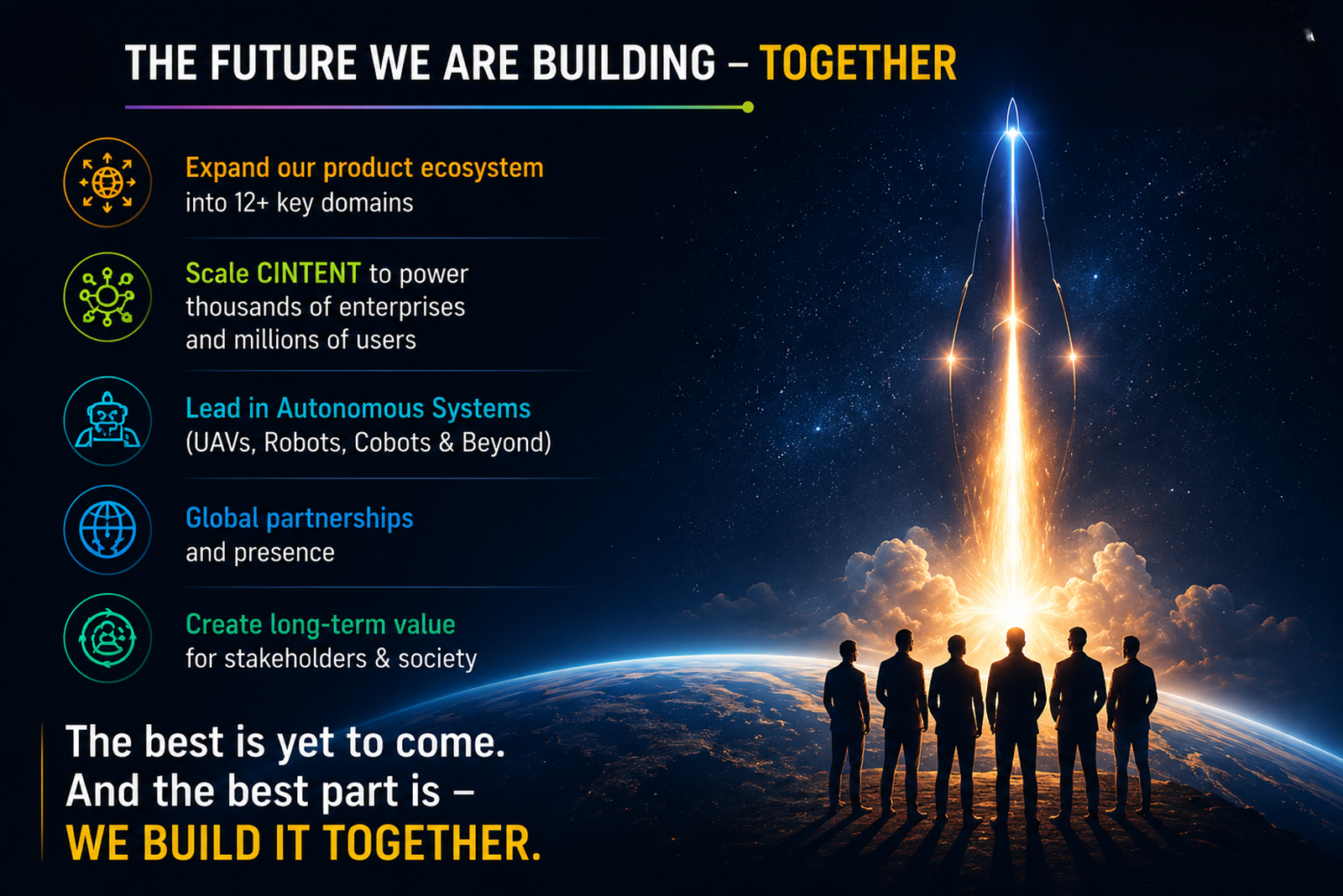
The same platform extends across legal intelligence, knowledge systems, wellbeing, mobility, robotics, and aerial autonomy.
Capabilities developed for one domain are designed to transfer to others — the platform is intended to get stronger as new domains contribute patterns.
Experience CINTENT's cognitive architecture firsthand — submit real scenarios and watch intent recognition, contextual reasoning, and decision synthesis happen in real time.
Legal analysis, travel planning, healthcare workflow, or custom scenario.
Contract text, case details, patient data — CINTENT integrates multi-source inputs automatically.
Risk assessments, scenario rankings, recommended actions — ready to integrate with your systems.
CINTENT is API-first. Send an intent, receive a governed, explainable decision. No wrappers around a chat model — a real reasoning pipeline behind every call.
{
  "intent": "Should we approve this claim?",
  "context": {
    "policy_id": "HP-2340",
    "history": ["diabetes", "prior_claim_2023"],
    "evidence": ["scan_9421.pdf", "note_112.txt"]
  },
  "governance": { "trace": true, "explain": true }
}

→ 200 OK
{
  "decision": "conditional_approve",
  "confidence": 0.87,
  "reasoning_trace": [
    { "step": "extract_evidence", "source": "scan_9421.pdf" },
    { "step": "policy_match",   "rule":   "HP-2340 §4.2"   },
    { "step": "risk_synthesis", "score":  0.13             }
  ],
  "audit_id": "aud_01HXY…"
}